


Central Air vs Mini Split for Northwest Indiana Homes: Which Is Right for You?
Central air vs mini split for northwest indiana homes is one of the most common questions homeowners across the region are asking right now — and for good reason. Northwest Indiana throws a lot at your HVAC system: humid summers near Lake Michigan, bitter sub-zero winters, and everything in between. Picking the wrong system means higher bills, uneven comfort, and headaches you don't need.
Here's a quick side-by-side to help you decide:
| Factor | Central Air | Mini Split |
|---|---|---|
| Best for | Homes with existing ductwork | Homes without ducts or needing zoning |
| Cooling efficiency | 14–22 SEER2 | 20–30+ SEER2 |
| Heating in NW Indiana winters | Paired with furnace | Hyper-heat models rated to -22°F; furnace still recommended |
| Installation disruption | High if no ducts exist | Minimal — small hole for refrigerant line |
| Zoning control | Limited (add-ons required) | Built-in, room by room |
| Humidity control | Good | Excellent (dry mode available) |
| Home type | New builds, ducted homes | Older homes, additions, no-duct situations |
The short answer: central air is the better fit if your home already has good ductwork. A mini split wins when you need zoning, have no ducts, or want higher efficiency. In Northwest Indiana's extreme cold, most HVAC experts recommend pairing a mini split with a furnace rather than relying on it as your sole heat source.
Read on for a full breakdown of both systems — costs, performance in Indiana's climate, and what local pros actually recommend.
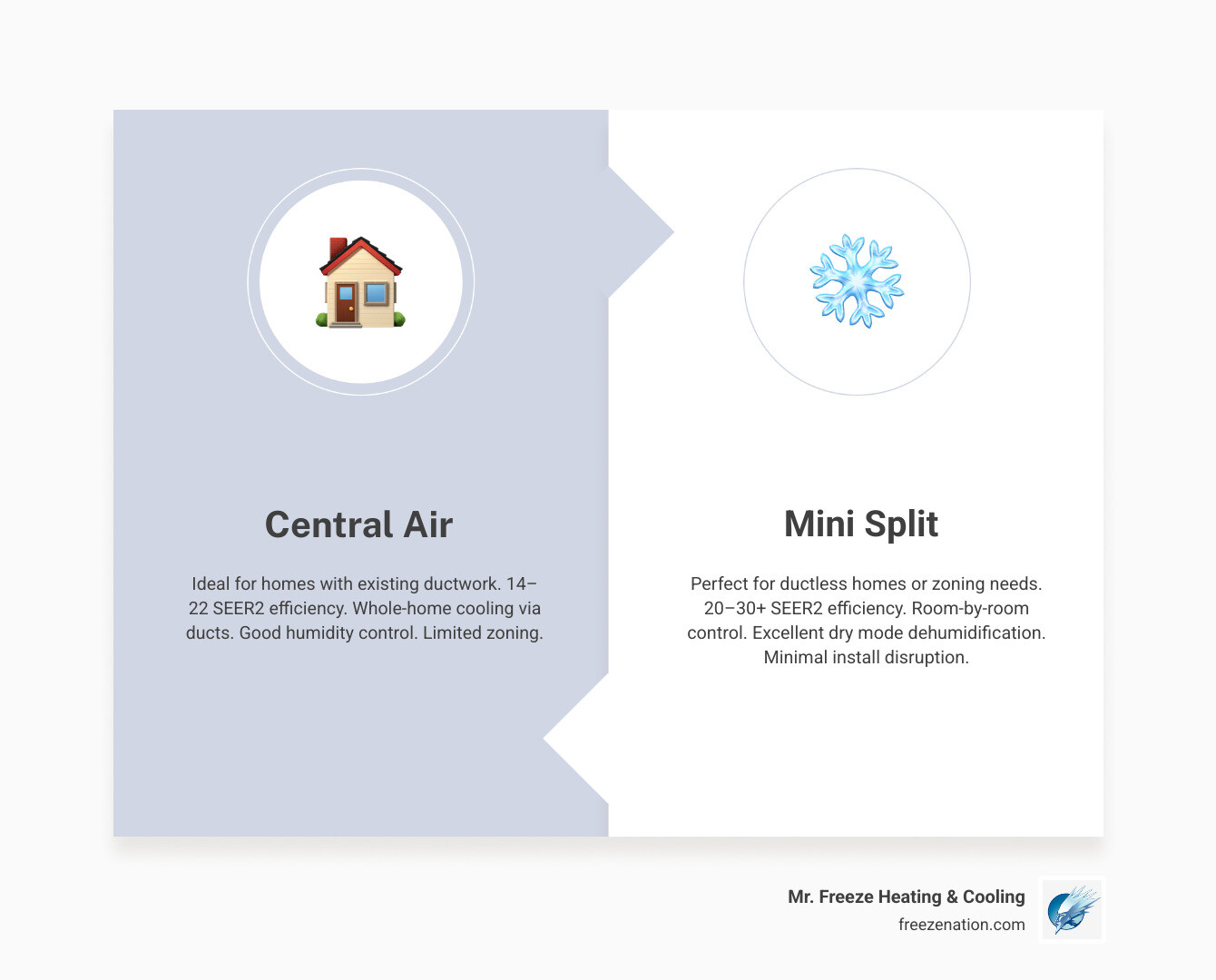
Comparing central air vs mini split for northwest indiana homes
When we sit down with families in Hammond or Munster to discuss their home comfort, we usually start by looking at the "bones" of the house. The debate over central air vs mini split for northwest indiana homes really comes down to how air moves through your rooms.
A traditional Air Conditioning system is what most of us grew up with. It uses a large outdoor compressor and an indoor evaporator coil (usually sitting on top of your furnace) to chill air and push it through a network of ducts. It’s a "whole-home" solution, meaning one thermostat controls the temperature for every room at once.
On the other hand, Ductless mini-split systems are the "new kids on the block" in many Indiana neighborhoods, though they’ve been the standard in Europe and Asia for decades. These systems consist of an outdoor unit connected to one or more indoor air handlers by small refrigerant lines. Because there are no ducts, you don't lose energy through leaks in the attic or crawlspace. At Mr. Freeze Heating & Cooling, Our Services include helping you determine which of these mechanical setups fits your lifestyle and your architecture.
How Central Air Systems Work in Local Homes
Central air is the "invisible" workhorse. If your home was built after the 1960s, you likely have a system of ducts hidden behind your walls. Central AC utilizes these existing paths to deliver uniform temperatures. One of the biggest perks of central air is that it often increases property value by up to 10%, as many buyers consider it a "must-have" for a modern home.
Furthermore, central systems are excellent for Indoor Air Quality. Because all the air in your home passes through a single, large filter at the furnace or air handler, you can install advanced filtration systems or UV lights to scrub out dust, pollen, and Lake Michigan allergens. However, if your ducts are old, leaky, or dirty, they can actually work against you, spreading dust and losing up to 30% of your cooling energy before it even reaches your bedroom.
The Benefits of a Mini Split for Northwest Indiana Homes
Mini-splits shine in their flexibility. If you’ve ever fought over the thermostat because the upstairs is a sauna while the basement is an icebox, a mini-split is your best friend. These systems offer true "zoning," allowing you to set the temperature in the kitchen to 72°F while keeping a home office at 68°F.
They also utilize advanced inverter technology. Think of a traditional AC like a light switch — it’s either 100% on or 100% off. Inverters are like a dimmer switch; they ramp up and down to maintain a steady temperature without the noisy "clunk" of a system starting up. For homeowners looking at a Ductless Installation - Dyer IN, the quiet operation is often the first thing they notice. Plus, in our Service Areas - St. John IN, we see many homeowners using mini-splits to reclaim "un-coolable" spaces like finished garages or sunrooms.
Performance During Extreme Indiana Weather Swings
Northwest Indiana is famous for its "wait five minutes and the weather will change" reputation. We deal with heavy humidity from Lake Michigan in July and "Polar Vortex" snaps in January. Your choice between central air and a mini-split needs to account for both.
Heating Capabilities of a Mini Split for Northwest Indiana Homes
Can a mini-split handle a Region winter? The answer is: it depends. Most standard mini-splits are technically Heat Pump systems, meaning they can reverse their cycle to provide Heating. However, basic models often struggle when the temperature drops below freezing.
For our climate, we recommend "Hyper-Heating" technology. Systems like the Mitsubishi Hyper-Heat models are rated to provide reliable warmth even when it’s -22°F outside. If you are considering a Heat Pump Installation - Highland IN, this is a game-changer. That said, as local experts, we still usually recommend having a backup furnace or boiler for those record-breaking cold nights. North of Kentucky, relying only on a heat pump can be risky unless the system is perfectly sized and designed for extreme cold.
Handling Humid Summers in the Region
In August, the humidity in places like Portage or Merrillville can make it feel like you’re walking through soup. Both systems dehumidify as they cool, but mini-splits have a slight edge here. Because they run for longer cycles at lower speeds (thanks to that inverter technology), they are better at pulling moisture out of the air without over-cooling the room.
Many mini-splits even feature a "Dry Mode." This setting focuses specifically on removing humidity without significantly dropping the temperature — perfect for those "sticky" 75-degree days. Whether you are in our Service Areas - Portage IN or Service Areas - Merrillville IN, keeping the humidity under 50% is key to preventing mold and keeping your family comfortable.
Efficiency, Zoning, and Installation Considerations
Efficiency is where the central air vs mini split for northwest indiana homes debate gets interesting. In 2026, energy standards are stricter than ever. Mini-splits are generally 20-30% more efficient than central AC systems. Why? Two reasons: higher SEER2 ratings (often 20-30+ compared to central air's 14-22) and the total absence of ductwork.
Multi-Room Comfort and Zoning Control
Zoning is the ultimate luxury in home comfort. With a central system, you’re cooling the guest room you haven't stepped in for three days just to keep your master bedroom comfortable. With a multi-zone mini-split, you simply turn off the units in unoccupied rooms.
In our Service Areas - Hobart IN and Service Areas - Dyer IN, we often see families save significantly on their monthly utility bills just by practicing "smart zoning." You aren't just saving energy; you’re giving everyone in the house their own personal thermostat.
Installation for Older Homes vs. New Builds
If you’re building a new home in Crown Point or Cedar Lake, central air is often the most cost-effective choice because the ducts are designed into the blueprints from day one. However, if you live in a beautiful historic home in Whiting or Hammond that was built before the 1960s, adding ductwork can be a nightmare. It requires cutting into original plaster walls, dropping ceilings, and losing closet space.
For these older homes, Ductless is a lifesaver. Installation is minimally invasive — we only need to drill a small three-inch hole to connect the indoor and outdoor components. This preserves the architectural integrity of the home while providing modern comfort. We’ve helped many residents in our Service Areas - Crown Point IN upgrade from noisy, inefficient window units to sleek, quiet mini-splits in just a single day.
Frequently Asked Questions about NWI Cooling
We know you have questions, and we’ve heard them all while serving Northwest Indiana since 2006. Proper maintenance and smart choices today lead to long-term satisfaction.
Can a mini split serve as the primary heat source in Northwest Indiana?
Technically, yes, if you choose a "Hyper-Heat" model designed for northern climates. These units can keep you warm even in sub-zero temperatures. However, for most homes in our region, we suggest using them as supplemental heat or pairing them with a furnace. If the power goes out or we hit a record-breaking cold snap, having that secondary heat source provides peace of mind.
Which system is better for homes without existing ductwork?
Ductless mini-splits are the clear winner here. Retrofitting a home with ducts can be incredibly expensive and disruptive. A mini-split offers a faster, cleaner installation. For a Ductless Installation - Dyer IN, you can often have your new system up and running in a fraction of the time it would take to install a ducted system.
How do maintenance requirements compare between the two?
Both systems need love to last!
- Central Air: You need to change the furnace filter every 1-3 months and have the ducts inspected for leaks or dust buildup every few years. You also need an annual Air Conditioning tune-up to clean the outdoor coils.
- Mini Splits: These have filters inside the indoor heads that you should wash yourself every 2-4 weeks. Because they don't have ducts, you save on duct cleaning costs, but you still need a professional to perform a deep clean of the blowers and coils once a year to prevent mold.
Regular maintenance is the best way to protect your Heating and cooling investment and ensure your Indoor Air Quality stays high.
Conclusion
Deciding on central air vs mini split for northwest indiana homes doesn't have to be a stressful choice. Whether you’re looking for the whole-home consistency of central air or the high-efficiency zoning of a mini-split, the team at Mr. Freeze Heating & Cooling is here to help.
Based in Hammond, we’ve been serving our neighbors since 2006 with honest pricing and a 100% satisfaction guarantee. From Service Areas - Highland IN to Service Areas - Munster IN and Service Areas - Schererville IN, we know exactly what it takes to keep a home comfortable in the unique Indiana climate.
Ready to upgrade your Air Conditioning? Contact us today for a free estimate and let us help you find the perfect cooling solution for your home!
Discover more articles

How to Prepare Your Air Conditioner for the First Hot Days of the Year
Learn how to prepare your air conditioner for the first hot days of the year with expert tips from Mr. Freeze. Learn more and stay comfortable all summer.

9 signs your HVAC system is having a midlife crisis
Spot when an HVAC failure is a true emergency: 9 signs like gas leaks, CO alarms & leaks. Protect your NW Indiana home—call now!
Why Northwest Indiana Residents Need a Spring HVAC Tune-Up
Schedule spring ac and hvac maintenance for northwest indiana now! Boost efficiency, cut bills 30%, ensure reliability before summer heat hits NWI.