


Is Your AC Trying to Tell You Something? Here's What Those Strange Noises Mean
AC making strange noises what they mean is one of the most common concerns homeowners in Northwest Indiana face — especially when summer humidity kicks in and your system is working overtime. The short answer: different sounds point to different problems, and some need attention right away.
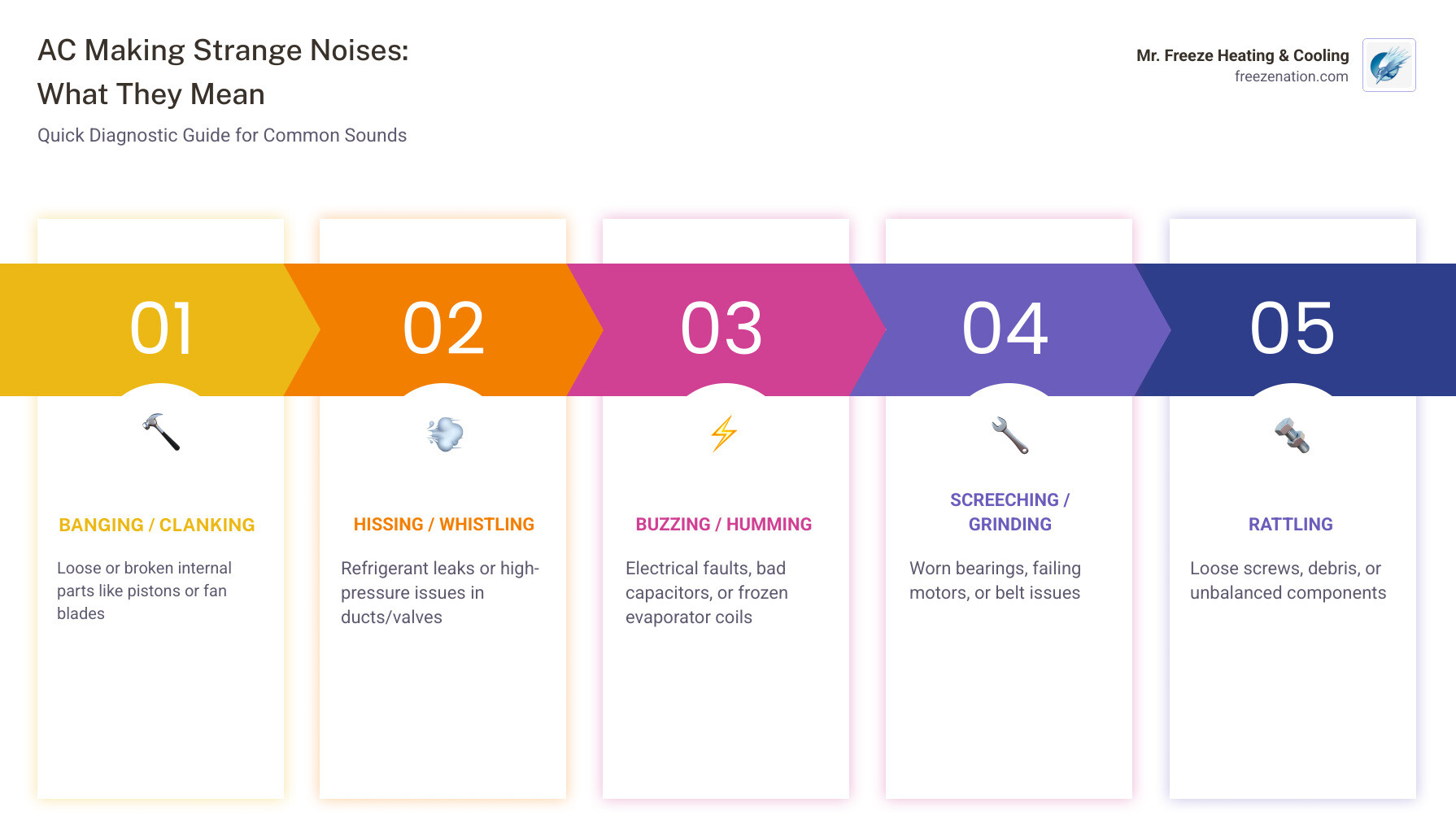
Here is a quick reference guide to the most common AC noises:
| Noise | Likely Cause | Urgency |
|---|---|---|
| Banging / Clanking | Loose or broken internal parts | High — shut off immediately |
| Hissing / Whistling | Refrigerant leak or duct issue | High — call a pro |
| Buzzing / Humming | Electrical fault or frozen coils | High — shut off immediately |
| Screeching / Grinding | Worn bearings or failing motor | High — shut off immediately |
| Rattling | Loose screws or debris | Medium — inspect soon |
| Clicking (repeated) | Thermostat or capacitor issue | Medium — schedule service |
| Bubbling / Gurgling | Drain line clog or refrigerant leak | Medium — call a pro |
| Soft click at startup | Normal relay operation | None — expected sound |
| Steady hum + air whoosh | Normal operation | None — expected sound |
Modern AC systems are engineered to run quietly — some newer variable-speed units operate as low as 19 decibels, which is softer than a whispered conversation. So when your system suddenly sounds like something is loose, leaking, or grinding, it is worth paying attention.
As one common pattern shows, homeowners who ignore an unusual noise for a few weeks often end up without cooling entirely during the hottest, most humid stretch of summer — a situation that is both uncomfortable and avoidable.
In this guide, we break down exactly what each noise means, which ones you can address yourself, and when it is time to call a professional.
Understanding Normal vs. Abnormal Operation
Before we dive into the "red flag" sounds, it is important to know what your air conditioner should sound like. When we visit homes in April 2026 to prep for the coming heat, we often remind our neighbors that a healthy AC is never perfectly silent, but its sounds should be consistent and unobtrusive.
A normal operating cycle begins with a soft, single click. This is the electrical relay engaging to send power to the outdoor unit. Following that, you should hear a steady, gentle hum from the compressor and the fan motor, accompanied by the soothing "whoosh" of air moving through your vents.
Modern, energy-efficient units—especially those with variable-speed motors—are designed for library-quiet operation. If you have a high-end system, it may be so quiet you barely notice it running at all. Another normal sound is the occasional "pop" or "thump" from your ductwork. This is usually just thermal expansion and contraction; as the metal ducts cool down or warm up, they physically shift slightly, creating a harmless sound.
However, if the "language" of your system changes from a steady hum to a harsh, disruptive, or erratic noise, it is time to investigate. Establishing a baseline for your unit's normal volume is the best way to catch an ac making strange noises what they mean before a small part failure turns into a total system breakdown.

AC Making Strange Noises What They Mean: A Diagnostic Guide
When your air conditioner starts acting like a noisy roommate, it is usually a symptom of one of three things: mechanical failure, electrical issues, or airflow restrictions. In Northwest Indiana, where humidity can reach grueling levels by July, these sounds are your system's way of asking for help.
Ignoring these warnings often leads to a "domino effect." For example, a loose screw might cause a rattle today, but if left alone, that vibration could eventually crack a refrigerant line or damage a fan blade. Catching these sounds early is the key to affordable Air Conditioning Repair Schererville IN and maintaining your home's comfort.
Banging and Clanking: Loose Internal Components
If your outdoor unit sounds like it is hosting a drum solo, you likely have a "high urgency" situation. Banging or clanking sounds almost always indicate that a part has come loose or broken entirely inside the system.
Inside the compressor—the "heart" of your AC—various components like the piston pin, connecting rod, or crankshaft can fail. Because the compressor is a sealed unit, these parts hitting the internal framing create a heavy banging sound. Unfortunately, once a compressor begins banging, it often signals the end of its life.
Clanking, on the other hand, is often related to the blower fan or the outdoor fan blades. If a blade becomes unbalanced or bent, it may strike other components as it spins. If you hear these sounds in your home, we recommend an immediate shutdown and a call for Air Conditioning Repair Crown Point IN to prevent further mechanical destruction.
Hissing and Whistling: AC Making Strange Noises What They Mean for Refrigerant
Hissing is one of the most distinct sounds an AC can make, and it usually points to one of two things: a refrigerant leak or high internal pressure.
A refrigerant leak in the coils or lines often creates a persistent hissing or bubbling sound. This is a serious issue because refrigerant is essential for heat exchange. If you suspect a leak, our team providing Air Conditioning Repair Munster IN can use specialized tools to find and seal the breach.
Whistling is slightly different. If the sound is coming from your vents, it usually indicates an airflow restriction. This could be an incompatible air filter, a blocked return vent, or even a leak in your ductwork where air is escaping through a small crack. If the whistling is coming from the outdoor unit, it could be a sign of high pressure in the compressor, which is a safety hazard. In these cases, reaching out for Air Conditioning Repair Dyer IN is the safest move.
Buzzing and Humming: Electrical Warnings
Buzzing is a "jack-of-all-trades" noise—it can mean many different things, but most of them are electrical. A common culprit is a defective contactor relay switch. This part is responsible for starting the outdoor unit; if it fails, it may buzz loudly without actually engaging the system.
Other causes of buzzing include:
- Loose Wiring: Electrical connections can loosen over time due to system vibrations.
- Failing Capacitor: This part provides the "jolt" of energy needed to start the motors.
- Frozen Coils: If your evaporator coils freeze over (often due to a dirty filter), the unit may emit a low buzzing sound as it struggles to breathe.
If you are in Hammond and hear this, Air Conditioning Repair Hammond IN can help diagnose the electrical fault. Sometimes, buzzing is simply caused by "vibration isolation" issues, where the rubber feet the compressor sits on have worn away. Our experts in Air Conditioning Repair Highland IN can quickly swap those out to restore the quiet.
Screeching and Grinding: Bearing and Belt Failures
A high-pitched screeching sound is often compared to nails on a chalkboard, and it is just as unpleasant for your AC as it is for your ears. In older units, this usually means a fan belt has slipped or is frayed. In modern units, which often use direct-drive motors without belts, screeching typically points to failing bearings in the fan motor or the blower motor.
Grinding is even more serious. It usually indicates that the motor bearings have completely worn down, leading to metal-on-metal contact. This creates immense heat and can cause the motor to burn out entirely. If you hear grinding in Hobart, don't wait—call for Air Conditioning Repair Hobart IN. For those in the Whiting area, addressing a squeal early with Air Conditioning Repair Whiting IN can often save you from the cost of a full motor replacement.
Distinguishing Between Indoor and Outdoor Unit Sounds
When you call us to report an ac making strange noises what they mean, one of the first questions we will ask is: "Where is the sound coming from?" Pinpointing the location helps us narrow down the culprit before we even arrive at your door.
| Sound Location | Common Noise | Potential Issue |
|---|---|---|
| Indoor Unit | Whistling / Wheezing | Dirty filter or blocked return air |
| Indoor Unit | Gurgling / Bubbling | Clogged condensate drain or refrigerant leak |
| Indoor Unit | Clicking (Repeated) | Control board or thermostat malfunction |
| Outdoor Unit | Banging / Clanking | Compressor failure or loose fan blade |
| Outdoor Unit | Hissing | High compressor pressure or refrigerant leak |
| Outdoor Unit | Screeching | Condenser fan motor bearing failure |
| Vents / Walls | Rattling / Popping | Loose ductwork or thermal expansion |
For residents needing AC Repair Portage IN, a bubbling sound from the indoor unit is a frequent call. This usually means the condensate drain line is clogged, causing water to back up. In Air Conditioning Repair St. John IN, we often find that "mysterious" wall vibrations are actually caused by refrigerant lines that weren't properly insulated or secured, allowing them to rattle against the studs.
DIY Troubleshooting for an AC Making Strange Noises What They Mean
While many AC noises require a pro with a toolbox, there are a few things you can check yourself. Before you do any of these, always turn off the power to your AC at the thermostat and the breaker for safety.
- Check the Filter: A whistling or "thumping" sound is often just a dirty air filter. If the filter is clogged, the blower fan has to work harder to pull air through, creating a vacuum effect that can make the filter rattle against its housing.
- Clear the Debris: If your outdoor unit is rattling, check for loose twigs, leaves, or stones that may have fallen through the top grille. Sometimes a "thwapping" sound is just a leaf hitting the fan blades.
- Tighten the Panels: Sometimes a "strange noise" is just a loose screw on the exterior cabinet. If you see a panel vibrating, a quick turn of a screwdriver can solve the problem.
- Inspect the Vents: Ensure no furniture or curtains are blocking your return or supply vents, which can cause whistling.
If you’ve tried these steps and the noise persists, it’s time to call in the experts. Whether you need Air Conditioning Repair Griffith IN or Air Conditioning Repair East Chicago IN, we are here to help.
The Importance of Regular Maintenance in Northwest Indiana
The best way to handle an ac making strange noises what they mean is to prevent the noise from ever starting. In our region, the transition from a chilly spring to a humid 90-degree summer happens fast. Regular Air Conditioning maintenance is the "secret sauce" to a quiet home.
Our VIP maintenance plan is designed to catch the small things—like dry bearings that need lubrication or a slightly loose fan belt—before they become loud, expensive repairs. During a typical tune-up, we:
- Lubricate all moving parts to prevent grinding.
- Tighten electrical connections to stop buzzing.
- Clean the coils to prevent the "wheezing" of a restricted system.
- Clear the drain lines to avoid gurgling and water damage.
Investing in Our Services isn't just about peace and quiet; it's about system longevity and energy efficiency. A well-maintained unit doesn't have to work as hard, which means lower utility bills for you.
Frequently Asked Questions about AC Noises
Is it safe to run my AC if it is making a loud noise?
It depends on the sound, but generally, the answer is no. If you hear banging, screeching, grinding, or hissing, you should turn the system off immediately. Running a unit with these sounds can cause catastrophic mechanical failure or even electrical fires. A light rattle might be okay for a few hours, but it should still be inspected soon.
Why does my air conditioner make noise after it shuts off?
It is normal to hear some "settling" sounds for a minute or two after the cycle ends. This is often the refrigerant pressures equalizing in the lines or the metal components contracting as they cool. However, if you hear a loud bang or a persistent hiss after shut-off, you may have a compressor mounting issue or a significant leak.
Can a dirty air filter cause my AC to make strange sounds?
Absolutely! A dirty filter is the number one cause of whistling, wheezing, and even thumping sounds. It restricts airflow so severely that the system can actually "choke," leading to frozen coils and buzzing motors. Changing your filter every 30–60 days is the easiest maintenance you can do.
Conclusion
When summer arrives in Northwest Indiana, you rely on your air conditioner to be your silent partner in comfort. If your system starts speaking up with bangs, hisses, or squeals, don't ignore the warning. Understanding ac making strange noises what they mean is the first step toward protecting your home and your wallet.
Since 2006, Mr. Freeze Heating & Cooling has been the trusted name from Hammond to Portage for honest pricing and expert service. We stand behind our work with a 100% satisfaction guarantee, ensuring that your home stays cool and quiet all season long.
If your AC is trying to tell you something, we are here to listen. Contact us today for a free estimate or to schedule your Air Conditioning service. Let’s make sure your only summer soundtrack is the sound of relaxation!
Discover more articles

Experience Matters More Than You Think When Your AC Dies
Discover how nearly 20 years of service builds trust in HVAC. Choose Mr. Freeze for reliable AC repairs in Northwest Indiana since 2006.

Why Your HVAC Needs a Local Expert Who Knows the Local Weather
Discover how local climate expertise translates to better solutions for NWI HVAC. Boost efficiency, air quality & resilience with expert tips!
The Ultimate Guide to Spring AC and HVAC Maintenance
Master spring ac and hvac maintenance: DIY tips, pro checklists & efficiency boosts for summer readiness in Northwest Indiana.