
Is Your Air Conditioner Failing to Beat the Indiana Heat?
Dealing with a failing cooling system during a humid Hammond summer creates immediate discomfort and safety concerns for your family, especially when humidity levels spike. Contact us today to schedule an estimate or discuss our financing options.
When your AC unit stops working efficiently, the resulting heat and humidity inside your home can become unbearable quickly. You need a solution that restores a controlled, comfortable environment without unnecessary delays or vague timeline promises. Mr.Freeze Heating & Cooling provides streamlined installation services designed to get your system running correctly the first time.
- Get your new AC installed quickly with our prioritized service scheduling.
- Enjoy clear, upfront pricing structures with absolutely no hidden fees.
- Benefit from a full manufacturer warranty and labor guarantee for all installation services.
- All installations comply strictly with local Hammond building codes and come with comprehensive warranty support.
Comprehensive AC Installation Services for Your Home
Selecting a new air conditioning system is a significant investment in your property and your long-term comfort. The process involves much more than simply swapping one metal box for another. A successful installation requires a technical assessment of your home’s thermal characteristics to ensure the new unit performs efficiently for years to come. In Hammond, where summer temperatures fluctuate and humidity remains high, installing a system that is perfectly matched to your specific square footage and insulation levels is critical.
Modern air conditioning systems are far more complex than units manufactured even a decade ago. They rely on advanced electronics, variable-speed motors, and specific refrigerant pressures to operate at peak efficiency. Our installation service covers every aspect of the transition from your old unit to a high-efficiency modern system. This includes the safe removal and disposal of the old equipment, inspection of existing ductwork to prevent air loss, and the precise calibration of the new thermostat and control systems.
We focus on delivering a turnkey solution. You receive a full assessment of your cooling needs based on the layout of your home, the number of windows, and the direction your home faces. This "Manual J" load calculation ensures the unit we install is neither too large nor too small. An oversized unit will short-cycle, failing to remove humidity effectively, while an undersized unit will run continuously without ever cooling the space. Our goal is to provide a system that maintains a consistent temperature while keeping energy consumption as low as possible.
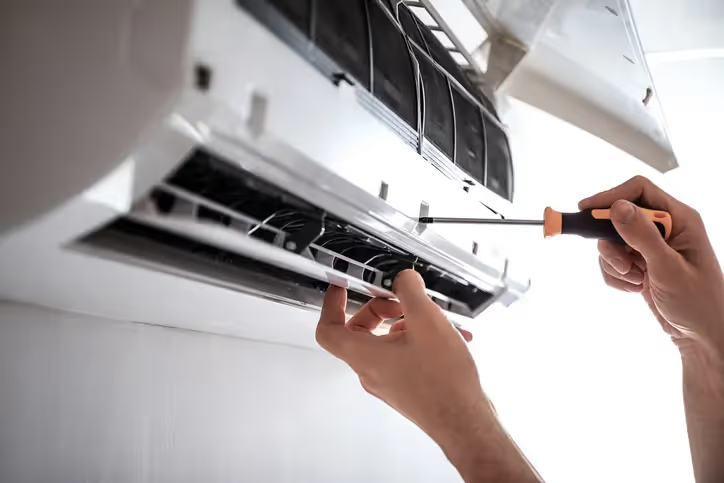
How the Installation Process Works
A professional installation is a systematic process designed to minimize disruption to your daily life while ensuring technical precision. We adhere to a strict protocol to ensure safety and quality control from the moment the truck arrives at your property until the final system test.
- Site Preparation and Protection: The process begins with protecting your property. Technicians lay down drop cloths and wear protective shoe covers to ensure your floors and home interior remain clean. The area around the outdoor condenser and indoor evaporator coil is cleared to provide safe access for the crew.
- System Decommissioning: Before the new unit can be installed, the old system must be safely decommissioned. This involves recovering the existing refrigerant in accordance with EPA regulations to prevent environmental contamination. Once the refrigerant is removed, the old electrical connections and line sets are disconnected, and the heavy equipment is carefully removed from the premises.
- Modifications and Positioning: If the new unit has different physical dimensions or requires updated airflow specifications, modifications to the plenum or transition ductwork are made. For the outdoor unit, the ground pad is inspected. If the existing pad is cracked or unlevel, it is replaced to ensure the new condenser sits on a stable, vibration-free foundation.
- Installation of New Components: The new evaporator coil is installed on top of the furnace or inside the air handler. Simultaneously, the outdoor condenser is positioned. A critical step involves brazing the copper refrigerant lines. Nitrogen is flowed through the lines during brazing to prevent oxidation buildup inside the pipes, which protects the compressor and valves from future damage.
- Electrical and Drainage Connections: High-voltage wiring is connected to the disconnect box, and low-voltage control wiring is run to the thermostat. A new condensate drain line is installed to ensure moisture removed from the air flows freely away from the system, preventing water damage to your home.
- Vacuum and Charge: Once the system is physically connected, a vacuum pump removes all air and moisture from the refrigerant lines. This creates a deep vacuum, which is essential for the system’s longevity. After the vacuum holds, the factory-specified amount of refrigerant is released or added to the system.
- Final Testing and Calibration: The system is powered on and tested. Technicians measure static pressure, temperature drop across the coil, and amperage draws to ensure every component is operating within manufacturer specifications. The thermostat is programmed, and the airflow is balanced for optimal distribution.
When to Replace vs. Repair Your AC Unit
Homeowners often struggle with the decision of whether to repair an aging unit or invest in a full replacement. While repairs can be cheaper in the short term, they are often a poor financial decision for systems that are nearing the end of their service life. Understanding when to stop putting money into a failing system helps you avoid the "money pit" scenario.
- The 50% Rule: A general industry standard is the 50% rule. If the cost of the repair approaches 50% of the value of a new system, replacement is the more logical choice. Investing half the cost of a new asset into an old one that has no warranty and lower efficiency rarely yields a positive return.
- Age of the Equipment: Air conditioners generally last between 10 and 15 years. If your unit is over 10 years old and requires a major repair—such as a compressor replacement or a fix for a significant refrigerant leak—it is often better to replace it. Parts for older units can be expensive and hard to source, and the technology in units over a decade old is significantly less efficient than current models.
- Rising Energy Bills: If you have noticed a steady increase in your cooling costs despite normal usage, your system’s efficiency has likely degraded. As internal components wear out, the system must work harder and draw more electricity to provide the same amount of cooling. Replacing an old 10 SEER unit with a modern 16+ SEER system can result in immediate and noticeable reductions in monthly utility bills.
- Inconsistent Comfort and Noise: If some rooms are freezing while others are hot, or if the unit makes excessive rattling, buzzing, or grinding noises, the system is struggling. These are signs of mechanical failure that simple repairs often cannot permanently resolve. A new installation corrects these airflow and mechanical issues, restoring quiet, even cooling throughout the home.
Local Considerations for Hammond Installations
Operating an air conditioning system in Northwest Indiana requires specific considerations due to the regional climate and local regulations. Hammond experiences hot, humid summers and severe winters, meaning the HVAC system must be robust enough to handle extreme shifts in weather.
- Permitting and Code Compliance: Hammond requires specific building permits for HVAC installations to ensure safety and adherence to energy codes. This includes verifying that the electrical circuit is sized correctly for the new unit and that the refrigerant lines are properly insulated. Professional installers handle the administrative burden of pulling these permits and scheduling the required municipal inspections, ensuring you are not liable for unpermitted work.
- Handling High Humidity: The humid continental climate in this region means your AC does more than just lower the temperature; it is your primary dehumidifier in the summer. If a system is not sized correctly for the latent heat load (humidity), your home will feel clammy even if the thermostat reads 72 degrees. We prioritize equipment that excels at humidity control, often recommending two-stage or variable-speed compressors that run longer at lower speeds to extract more moisture from the air.
- Utility Rebates and SEER2 Standards: Local utility providers often offer rebates for upgrading to high-efficiency systems. Furthermore, recent Department of Energy regulations have shifted to SEER2 ratings, which require more rigorous testing conditions. Mr.Freeze Heating & Cooling ensures that all installed equipment meets these new federal and regional efficiency standards, helping you qualify for available incentives while staying compliant with the law.
Choosing the Right System Efficiency
Efficiency ratings are a primary factor in the total cost of ownership. The Seasonal Energy Efficiency Ratio (SEER, now moving to SEER2) measures how much cooling a system delivers for each unit of electricity it consumes. The higher the rating, the less electricity the unit uses.
- Single-Stage Systems: These are the standard entry-level options. They operate at 100% capacity whenever they are on. They are the most affordable upfront but can be less efficient and less effective at dehumidification compared to advanced models.
- Two-Stage Systems: These units have a compressor that can run at two speeds: high and low. Most of the time, the unit runs on low, which saves energy and keeps the temperature more consistent. It kicks into high gear only on the hottest days of the year.
- Variable-Speed Systems: These represent the pinnacle of comfort and efficiency. The compressor can adjust its output in tiny increments, running almost continuously at very low power. This eliminates temperature swings and provides superior humidity control, which is particularly beneficial during Indiana summers.
The Importance of Correct Sizing
One of the most common issues we encounter with existing setups is incorrect sizing. A "bigger" AC is not necessarily better. If an AC unit is too powerful for the square footage it serves, it will cool the air too rapidly. The thermostat will reach the set temperature and shut the unit off before it has had time to cycle the air through the filter and remove the humidity. This leads to "short cycling," which increases wear on the compressor and results in high energy bills.
Conversely, a unit that is too small will run continuously, struggling to reach the target temperature on hot afternoons. This places immense strain on the components, leading to premature failure. We utilize industry-standard load calculation software to determine the exact cooling requirements of your specific home layout. This calculation accounts for insulation quality, window surface area, ceiling height, and even the heat generated by appliances and occupants.
Secure Your Comfort Today
A reliable air conditioning system is a necessity, not a luxury, when the temperatures begin to climb. Delaying the replacement of a failing unit often leads to emergency situations at the most inconvenient times. By choosing a professional installation now, you ensure a predictable, cool, and safe environment for your home. You gain the peace of mind that comes with a manufacturer’s warranty, professional workmanship, and a system designed to handle the specific demands of the local climate.
Do not wait for a complete system breakdown to address your cooling needs. Upgrade your home’s comfort and efficiency with a verified, code-compliant installation.
Schedule your installation assessment now to ensure your home stays cool all summer.