
Unsure if your home meets healthy safety standards or worried about potential pollutants affecting your family's respiratory health? You are not alone in facing these concerns, especially in regions like Hammond where seasonal shifts and industrial activity can heavily influence what gets trapped inside your living space. If you suspect your indoor environment is compromised, contact us immediately to schedule a comprehensive assessment or ask about our financing options.
We provide a definitive answer to your concerns through scientific analysis and professional diagnostics. Rather than guessing at the source of allergies or stale air, our testing provides data-driven clarity.
- Receive detailed air quality testing results and a clear plan of action within 24 hours of lab analysis.
- Get professional consultation on exactly how to regulate humidity and filtration for long-term consistency.
- Gain assurance of compliance with safety standards regarding carbon monoxide and volatile organic compounds.
All services are performed by certified technicians with over a decade of local experience in identifying residential pollutants.
Comprehensive Indoor Air Quality Analysis: What to Expect
When you schedule an air quality test, the goal is to identify invisible contaminants that standard HVAC filters might miss. Residents in Hammond often deal with a mix of industrial byproducts from the surrounding area and biological growth due to regional humidity. A professional test goes beyond a simple visual inspection; it utilizes advanced monitoring equipment to detect particulate matter, gases, and biological stressors.
The scope of our testing services includes a multi-point inspection of your home's airflow and contaminant levels. We do not simply walk in and sniff the air. The process involves deploying calibrated sensors and collecting air samples from key living areas, basements, and near HVAC intakes.
Upon completion of the testing phase, you receive a detailed report. This is not just a list of chemical names; it is a breakdown of what is in your air compared to healthy residential standards. You will see specific levels for various contaminants and receive a prioritized list of recommendations. These recommendations might range from installing UV germicidal lights and whole-home dehumidifiers to simple ventilation adjustments. The service focuses on identifying the root cause of the pollution, whether it is off-gassing from furniture, mold growth in ductwork, or infiltration from the outdoors.
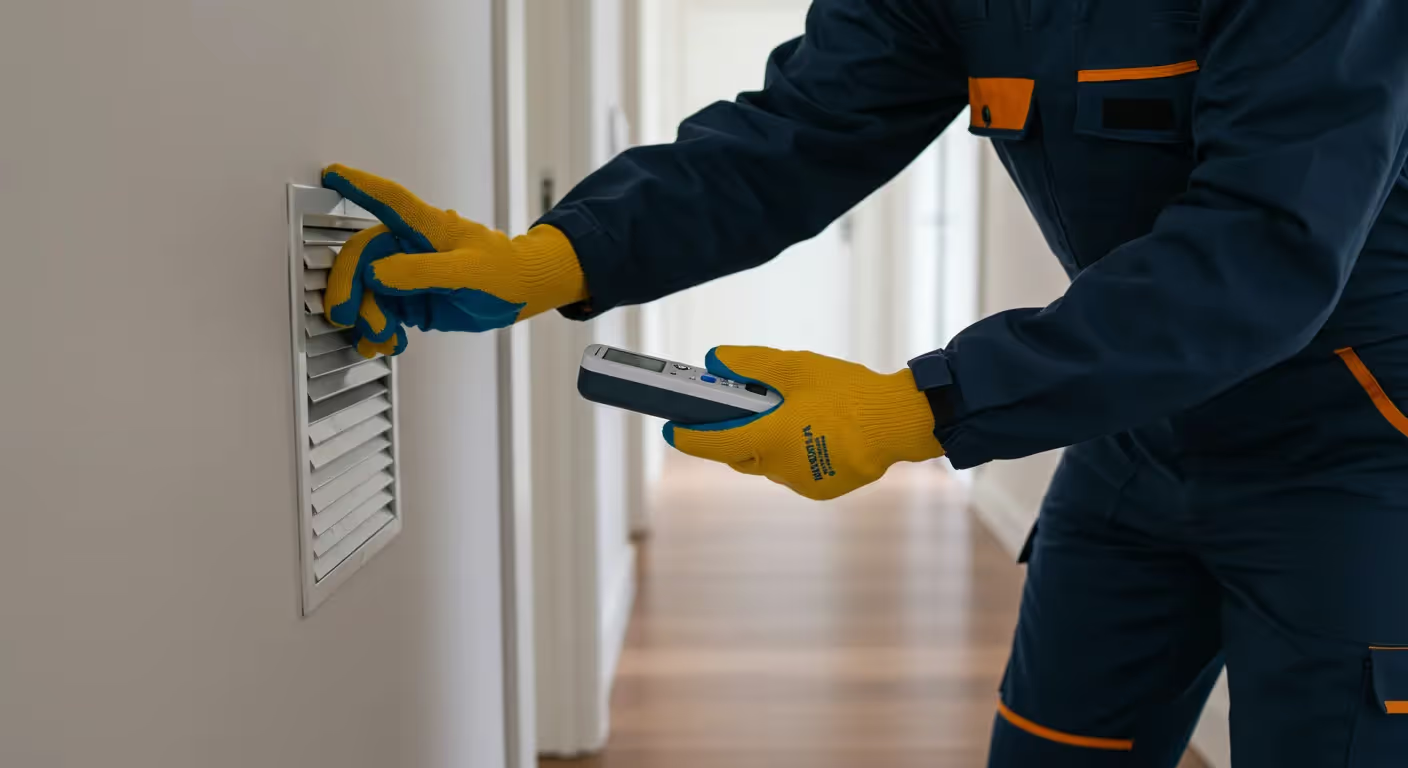
The Testing and Diagnosis Process
Understanding the condition of your indoor air requires a systematic approach. We adhere to a strict protocol to ensure that the samples we collect are representative of the air you breathe daily. This process ensures that the data we provide is accurate and actionable.
- Initial Site Survey and Visual Inspection
- The technician arrives and conducts a walkthrough to identify visible sources of contamination.
- They look for signs of moisture intrusion, mold growth on surfaces, or dust buildup in vents.
- Potential pollutant sources such as paint, cleaning chemicals, or attached garages are noted to correlate with sensor data later.
- Sensor Deployment and Sampling
- Specialized air quality monitors are placed in central living areas to measure real-time levels of Particulate Matter (PM2.5 and PM10).
- Technicians test for Volatile Organic Compounds (VOCs) which are gases emitted from certain solids or liquids.
- Humidity and temperature readings are taken to check for conditions that promote mold growth.
- If biological contaminants are suspected, surface swabs or specific spore-trap air samples are collected for laboratory analysis.
- HVAC System Evaluation
- The technician inspects the furnace and air conditioner to ensure they are not circulating contaminants.
- Filter efficiency is evaluated to see if the current setup is adequate for the home’s specific needs.
- Ductwork is checked for leaks that could be pulling in dirty air from attics or crawlspaces.
- Data Analysis and Reporting
- Instant reading data is compiled immediately for discussion.
- Lab samples are processed to identify specific mold species or allergen types.
- A final consultation is held to explain the findings and propose specific equipment or repairs to rectify the issues.
Deciding When to Test: Symptoms vs. Routine Checks
Many homeowners view air quality testing as a luxury, but in many cases, it is a necessity for health and safety. Unlike a broken furnace which stops producing heat, poor air quality is often silent until physical symptoms appear. Knowing when to move from assuming your air is fine to ordering a professional test is critical for maintaining a healthy home environment.
Physical Symptoms and Health Indicators
If family members experience symptoms that improve when they leave the house and return when they come back, the environment is likely the culprit.
- Persistent headaches, dizziness, or fatigue that cannot be explained by other illnesses.
- Worsening asthma or allergy symptoms, specifically during the night or when the HVAC system is running.
- Dryness or irritation in the throat, nose, and eyes, which often points to humidity imbalances or high particulate counts.
Environmental Changes and Events
Certain life events or changes to the property should trigger an immediate air quality assessment.
- Renovations: Remodeling projects often stir up asbestos, lead dust, or fiberglass, and introduce high levels of VOCs from new flooring, paint, and adhesives.
- New Home Purchase: Before moving into a home in Hammond, testing ensures you are not inheriting a previous owner's mold problem or pet dander issues.
- Water Damage: After a basement flood or roof leak, testing is required to verify that moisture has not led to hidden mold colonization behind drywall.
- Draft-Proofing: Tightening a home for energy efficiency can accidentally trap pollutants inside; testing ensures that ventilation remains adequate after insulation upgrades.
Regional Factors Impacting Hammond Homes
The environment in Hammond, IN, presents specific challenges that make air quality testing a vital service for local homeowners. The intersection of regional climate patterns and the industrial nature of the broader area means that homes here fight a battle on two fronts: external pollution infiltration and internal climate control issues.
Seasonal Climate Challenges
The local climate oscillates between cold, snowy winters and hot, humid summers.
- Winter: Average lows in the mid-20s mean homes are sealed tight to conserve heat. This "tight envelope" prevents fresh air exchange, causing indoor pollutants like cooking gas, pet dander, and VOCs to accumulate to dangerous concentrations. This is often when Carbon Monoxide risks are highest.
- Summer: Highs in the 90s combined with heavy rainfall (36-40 inches annually) create a breeding ground for mold. If your AC is not sized correctly or if your humidity control fails, biological growth can spread rapidly through ductwork.
Local Industrial and Environmental Context
Being located in a region with heavy industry and high traffic corridors, homes in this area are subject to higher outdoor levels of combustion byproducts.
- External particulates can seep into homes through cracks and open windows, settling in carpets and furniture.
- Sewer gas or soil vapor intrusion is a potential risk in certain older neighborhoods or areas with specific water table levels.
- Mr.Freeze Heating & Cooling understands these specific regional loads and calibrates testing equipment to differentiate between standard household dust and industrial particulate infiltration.
Why Professional Analysis is Essential
Store-bought test kits provide a snapshot at best and misleading data at worst. A professional service offers a depth of analysis that DIY options cannot match. When you hire a professional service, you are paying for the interpretation of the data as much as the data itself.
- Accuracy of Equipment: Consumer-grade monitors often lack the sensitivity to detect low-level VOCs or differentiate between types of particulate matter. Professional equipment is regularly calibrated and capable of detecting contaminants in parts per billion. This precision is necessary to catch issues before they become health hazards.
- Holistic House Diagnostic: A test result showing "High Mold" is useless without knowing why the mold is there. Professional testing is paired with building science. The technician determines if the issue is a ventilation failure, a drainage issue, or an HVAC sizing problem. This prevents you from spending money on air purifiers when the real solution might be a simple duct repair or dehumidifier installation.
- Actionable Roadmaps: The output of our service is not just a warning; it is a solution. You receive a step-by-step guide on how to fix the problem. This might include recommendations for specific MERV-rated filters, energy recovery ventilators (ERVs), or UV-light purification systems. We prioritize solutions that offer the highest impact on health and comfort.
Common Indoor Pollutants We Detect
Our testing protocols are designed to identify a broad spectrum of contaminants. Understanding what might be floating in your living room helps prioritize the right remediation strategy.
- Volatile Organic Compounds (VOCs): These are emitted as gases from certain solids or liquids. Common sources include paints, wood preservatives, aerosol sprays, cleansers and disinfectants, moth repellents, and air fresheners. High levels can cause eye, nose, and throat irritation, headaches, and damage to the liver, kidney, and central nervous system.
- Biological Pollutants: This category includes mold, bacteria, viruses, pollen, and dust mites. These require moisture to thrive. In humid Indiana summers, these can explode in population if humidity is not kept below 50%.
- Carbon Monoxide (CO) and Combustion Gases: Odorless and colorless, these gases are produced by fuel-burning appliances. Testing ensures that furnaces, water heaters, and stoves are venting properly and not back-drafting into the home.
- Radon: A radioactive gas that comes from the natural decay of uranium in soil. It can move up through the ground to the air above and into your home through cracks and other holes in the foundation.
- Particulate Matter (PM2.5/PM10): Tiny particles of dust, dirt, soot, or smoke. These are small enough to be inhaled deep into the lungs, causing respiratory issues.
Technical Solutions for Clean Air
Once testing reveals the composition of your indoor air, the next step is implementation. There is no "one size fits all" solution for air quality. The strategy depends entirely on the data gathered during the assessment.
- Source Control: The most effective way to improve air quality is to eliminate individual sources of pollution or to reduce their emissions. This might involve sealing asbestos, adjusting gas stoves, or removing mold-infested carpets.
- Improved Ventilation: Increasing the amount of outdoor air coming indoors helps lower concentrations of indoor air pollutants. However, in Hammond, this must be done through controlled mechanical ventilation (like ERVs/HRVs) to avoid bringing in too much humidity or outdoor pollution.
- Air Cleaning: Air cleaners and whole-home filtration systems can be effective at removing particles. Options range from media air cleaners that trap physical dust to UV lights that neutralize biological contaminants like viruses and mold spores.
Moving Forward with Healthy Air
Your home should be a sanctuary, not a source of illness. Ignoring the signs of poor air quality can lead to long-term health issues and structural damage to your property. By choosing to test, you are taking a proactive step toward a safer living environment.
We provide the expertise required to navigate the complexities of indoor environmental quality. From the initial sensor check to the final installation of air purification systems, our focus remains on precision and results. Do not let unseen pollutants compromise your comfort or safety.
For a definitive assessment of your home's environment and a clear path to cleaner air, contact Mr.Freeze Heating & Cooling today.