


I’m looking to upgrade my home's cooling. How does a mini split vs central ac cost comparison look in 2026?
Mini split vs central ac cost comparison is one of the most common questions Northwest Indiana homeowners face when it's time to upgrade or replace their cooling system — and the answer isn't as simple as picking the cheaper sticker price.
Here's a quick breakdown to address what most people want to know right away:
| Factor | Mini Split | Central AC |
|---|---|---|
| Best for homes with existing ductwork | No | Yes |
| Best for homes without ductwork | Yes | No |
| Upfront cost (with existing ducts) | Moderate | Lower |
| Upfront cost (no ductwork) | Lower | Much higher |
| Energy efficiency | Higher (SEER2 up to 35) | Moderate (SEER2 up to 26) |
| Zoned temperature control | Yes | Limited |
| Heating included | Yes (heat pump) | No (separate system needed) |
| Long-term operating costs | Lower | Higher |
| Federal tax credit eligibility | Up to $2,000 | Up to $600 |
The real deciding factor isn't brand or style — it's your home's existing ductwork. Homes that already have well-maintained ducts can often get central AC installed for less upfront. But homes without ducts — including many older homes throughout Hammond, Munster, and Highland — can face a dramatically different cost picture when ductwork installation is factored in.
On top of that, mini splits use roughly 30% less energy than central air on average, according to Department of Energy data on duct losses alone. Over 10 to 15 years, those monthly savings add up in a big way.
This guide walks through every layer of the cost comparison — installation, energy use, tax credits, maintenance, and long-term value — so you can make a confident decision for your home.
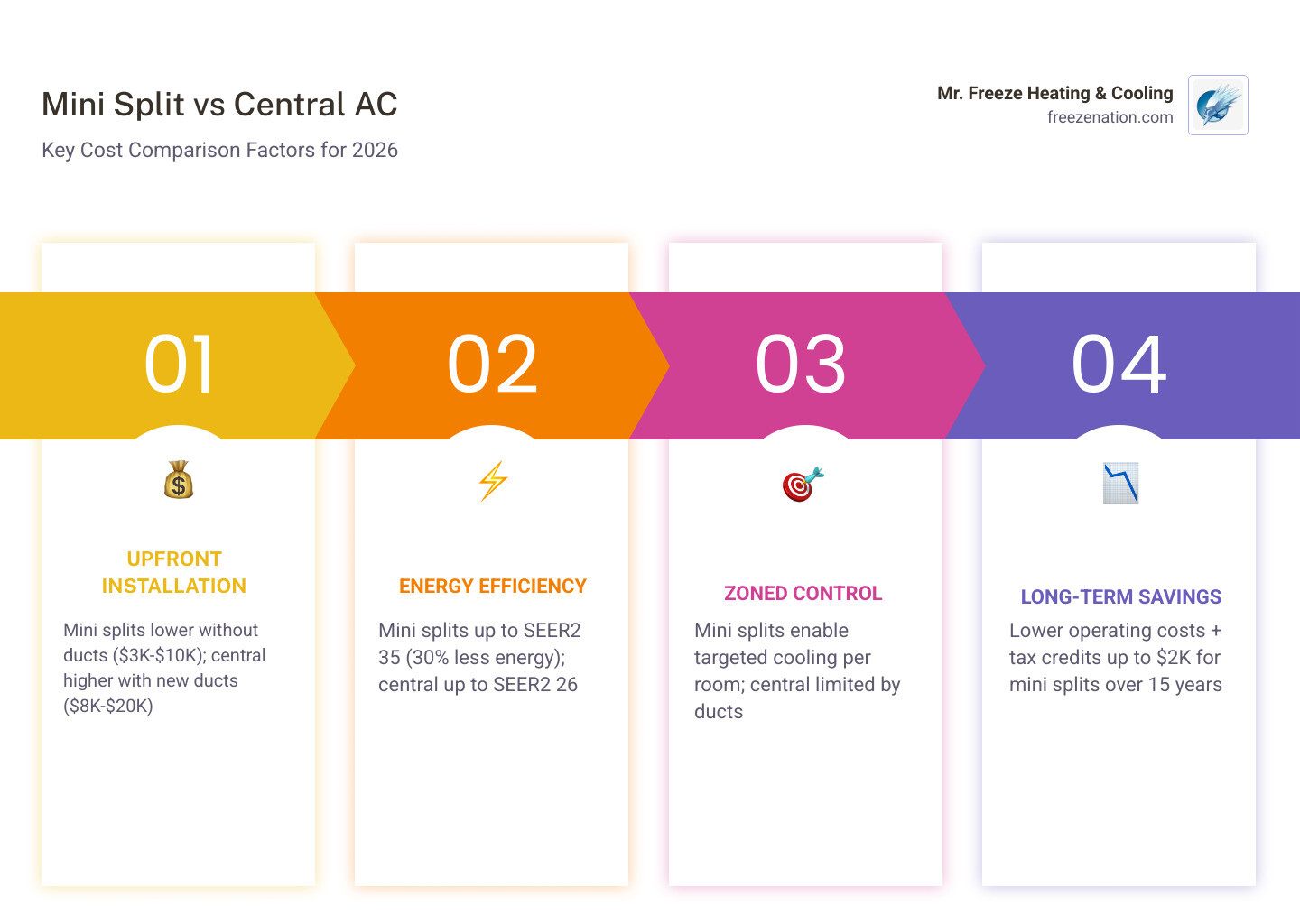
As we move through 2026, the landscape of home cooling has shifted. New federal efficiency standards and advancements in inverter technology have made both Air Conditioning and Ductless Mini Splits more effective than ever. However, when we look at the mini split vs central ac cost comparison, the "sticker price" is only the beginning of the story.
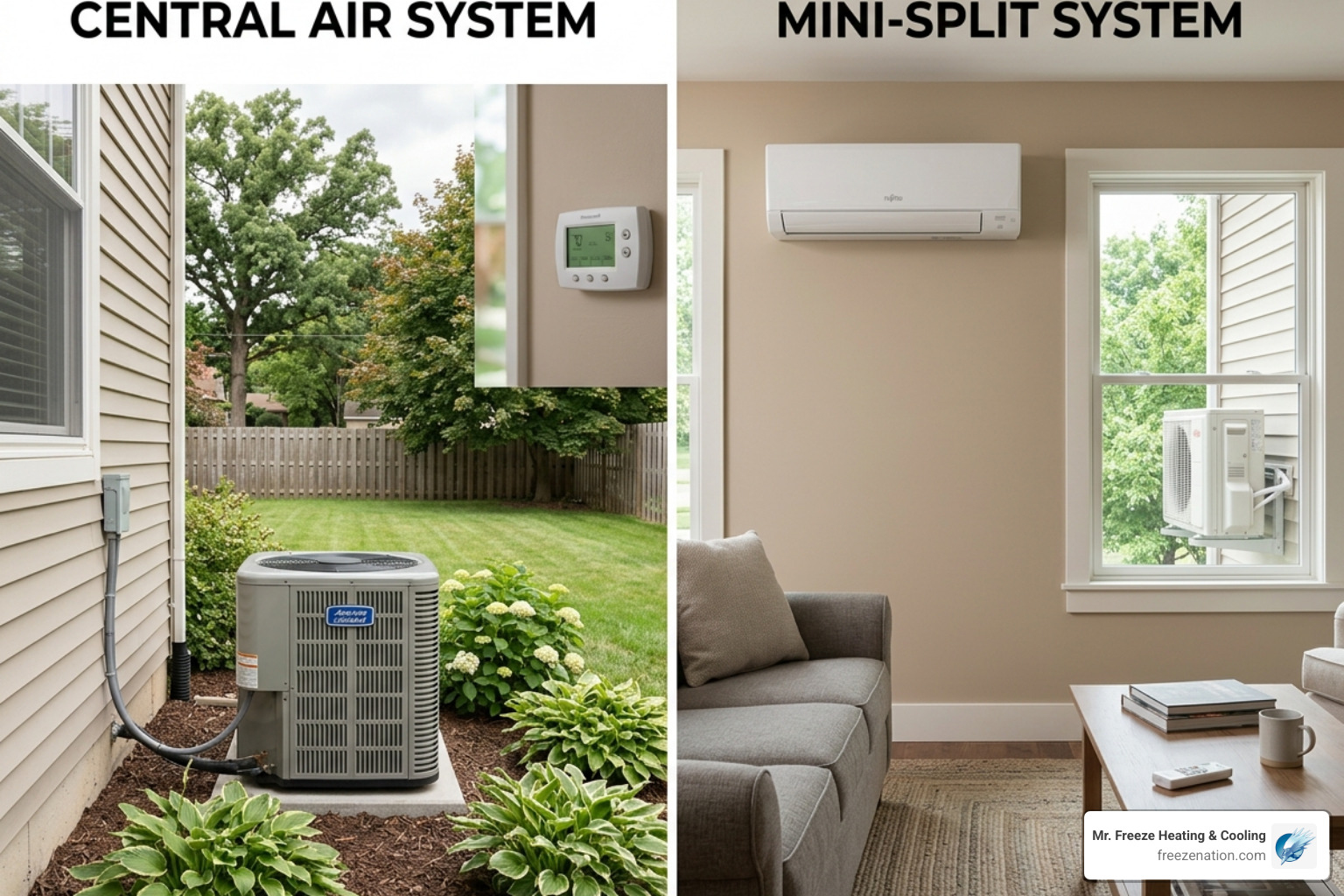
Installation complexity plays a massive role in your total investment. A central AC system relies on a single, large outdoor condenser connected to an indoor evaporator coil, which then pushes air through a network of ducts. If your home layout already supports this, the labor involved is relatively straightforward.
On the other hand, a mini split system involves an outdoor unit connected to one or more indoor "heads" mounted on walls or ceilings. While this avoids the need for massive metal tubes running through your crawlspace or attic, the cost scales with the number of zones you need. For a whole-home solution in a typical 2,500 sq ft Northwest Indiana home, you might need four or five zones to ensure every bedroom and living area stays crisp.
Is my home’s existing ductwork making central air more expensive?
This is the "hidden" variable that catches many homeowners off guard. If you live in an older home in Whiting or East Chicago that was built before central air was standard, you likely don't have ducts. Retrofitting a house with a full duct system is a major construction project. It involves cutting into plaster walls, dropping ceilings, and losing closet space.
Furthermore, even if you have ducts, they might be costing you more than you realize. The Department of Energy reports that typical duct systems lose 20% to 30% of conditioned air through leaks and poor insulation. When air leaks into your attic instead of your living room, your unit has to work harder, driving up your monthly bills.
Why a mini split vs central ac cost comparison favors ductless in older homes
For historic homes or those with space constraints, Ductless Mini Splits are often the clear winner. Traditional ductwork requires significant structural modifications that can ruin the aesthetic of a vintage home. Mini splits only require a small three-inch hole in the exterior wall for the refrigerant lines, preserving the integrity of your home while providing targeted cooling exactly where you need it.
| Feature | Central AC (Ducted) | Mini Split (Ductless) |
|---|---|---|
| Installation Impact | Major (requires wall/ceiling space) | Minor (small wall penetration) |
| Air Distribution | Uniform through vents | Zoned per indoor unit |
| Air Leakage | 20-30% loss common | 0% (no ducts to leak) |
| Aesthetics | Hidden behind walls | Visible indoor wall units |
Impact of duct losses on monthly utility bills
When we perform Our Services across Northwest Indiana, we often find that central systems are fighting an uphill battle. If your ducts run through an unconditioned attic that reaches 140 degrees in July, the cool air inside those ducts warms up before it ever hits your bedroom. This airflow resistance and heat transfer mean you're paying for cooling that you never actually feel. Because mini splits deliver air directly into the room, they bypass this waste entirely.
Which system offers the best long-term value for energy efficiency?
Efficiency is measured by SEER2 (Seasonal Energy Efficiency Ratio) and HSPF2 (Heating Seasonal Performance Factor). In 2026, standard central AC units typically range from 14 to 26 SEER2. However, mini splits are the heavyweights of efficiency, with some models reaching an incredible 35 SEER2.
The secret lies in inverter technology. Traditional central AC units are often "all or nothing"—they blast at 100% capacity until the thermostat is satisfied, then shut off. Mini splits use variable-speed compressors that ramp up and down smoothly, maintaining a consistent temperature using only the minimum amount of electricity needed.
Analyzing the mini split vs central ac cost comparison through energy savings
The ability to use "zoned cooling" is where the mini split vs central ac cost comparison really starts to favor the ductless side for long-term value. With a central system, you are cooling the entire house, including the guest room you haven't stepped into for three days. With a mini split, you can turn down the cooling in the kitchen and living room at night while keeping only the bedrooms at a comfortable 68 degrees. This targeted approach can reduce your summer electric bills by 20% to 40% compared to a non-zoned central system.
Total cost of ownership over fifteen years
When looking at the Total Cost of Ownership (TCO), we have to consider more than just the day of installation.
- Central AC: Over 15 years, you'll likely face duct cleaning costs, potential duct repairs, and higher monthly utility bills.
- Mini Split: While the upfront cost for a multi-zone system can be higher, the energy savings and the fact that it doubles as a high-efficiency Heat Pump for Heating often lead to a lower TCO.
Research suggests a 15-year TCO of roughly $23,500 for central air compared to $19,500 for a 3-zone mini split, thanks to the massive reduction in energy consumption.
Can I use federal tax credits to make my HVAC installation more affordable?
One of the best ways to tip the scales in your favor is by taking advantage of the Inflation Reduction Act. In 2026, federal tax credits (Section 25C) are a major factor in the mini split vs central ac cost comparison.
Qualifying ENERGY STAR mini-split heat pumps can earn you a 30% tax credit, capped at $2,000 per year. Because central AC units only provide cooling, their tax credit is significantly lower—usually capped at just $600. This $1,400 difference in federal incentives can make the more efficient mini split system much more accessible.
Qualifying for heat pump incentives in 2026
To qualify for the maximum credit, the system must meet specific efficiency thresholds (typically a SEER2 of 16.0 or higher). At Mr. Freeze, we can help you navigate these Promotions and even discuss Financing options to ensure you get the best technology for your budget.
Reducing long-term expenses with a professional maintenance plan
Regardless of which system you choose, the best way to protect your investment is through a Maintenance Plan. Our VIP Plan includes seasonal tune-ups that keep your system running at peak efficiency. For mini splits, this involves cleaning the specific filters and coils in each indoor head; for central AC, it includes inspecting the ductwork and the large evaporator coil. Regular care prevents performance degradation and extends the life of your equipment.
What are the best cooling options for homeowners in Northwest Indiana?
Living in areas like Hammond, Munster, or Highland means dealing with high summer humidity and bitter winter winds. Your cooling system needs to be robust enough to handle the "Lake Effect" weather.
For many of our neighbors, the choice comes down to how they use their homes. If you have a two-story home where the upstairs is always 10 degrees hotter than the downstairs, a central AC system without sophisticated Specialty Services like electronic zoning will struggle to keep you comfortable.
Addressing hot spots in multi-story homes
Mini splits excel at fixing "problem rooms." If you have a finished attic in Crown Point or a sunroom in St. John that stays hot no matter what the thermostat says, a single-zone mini split can provide the supplemental cooling needed to make that space usable again. We provide expert service across all our Locations to ensure every room in your house is a comfort zone.
Enhancing indoor air quality during system replacement
When we replace a system, we also look at your indoor air quality. Central AC systems allow for the integration of whole-home humidifiers and high-grade HEPA filtration. Mini splits offer multi-stage filtration in each unit, which is excellent for reducing allergens in specific rooms. Both systems can be equipped with advanced air purification technology to keep your family breathing easy during allergy season.
Frequently Asked Questions about Cooling Systems
Is a mini split more efficient than central air?
Yes, in almost every scenario. Mini splits avoid the 20-30% energy loss associated with ductwork and use inverter technology to run at variable speeds, whereas many central units are single-speed.
Can a mini split provide heating during Indiana winters?
Absolutely. Most mini splits installed today are heat pumps. Modern "cold-climate" models can provide effective heating even when Northwest Indiana temperatures drop well below zero. This makes them a "two-for-one" value for homeowners.
Does adding central air increase my home's resale value?
Historically, central air has been the "gold standard" for resale value because buyers expect it. However, in 2026, high-efficiency multi-zone mini splits are becoming highly desirable for energy-conscious buyers, especially in older homes where adding ducts would be destructive.
Conclusion
At Mr. Freeze Heating & Cooling, we’ve been serving Northwest Indiana since 2006 with a simple mission: honest pricing and a 100% satisfaction guarantee. Whether you decide that a traditional central system is best for your existing ducts or you want to join the thousands of homeowners switching to high-efficiency ductless technology, we are here to help.
The mini split vs central ac cost comparison doesn't have a single "right" answer for everyone, but there is a right answer for your home. Don't guess when it comes to your comfort and your wallet.
Schedule your professional cooling assessment today and let us help you find the most cost-effective way to stay cool all summer long.
Discover more articles
The Best Cooling Solutions for Northwest Indiana Homeowners
Discover central air vs mini split for northwest indiana homes. Compare efficiency, zoning & installation for extreme weather comfort.
Is Your AC Trying to Tell You Something? Decoding Weird Noises
Decode ac making strange noises what they mean: banging, hissing, buzzing. NW IN guide + repair tips!

The Northwest Indiana guide to surviving a sudden HVAC breakdown
Learn what to do when your hvac breaks down unexpectedly in Northwest Indiana. Safety steps, troubleshooting & emergency tips from Mr. Freeze.