
Keep Your Wine Perfectly Chilled
Facing difficulties maintaining the right climate for your wine collection can compromise flavor profiles and ruin your investment quickly, so contact us today to schedule a consultation or inquire about financing options. Mr.Freeze Heating & Cooling provides advanced wine cellar cooling solutions to ensure your wine ages perfectly, specifically addressing the distinct humidity and temperature challenges found in Dyer, IN. Standard air conditioning cannot replicate the precise environment required for long-term storage, making specialized equipment necessary for any serious collector.
- Achieve and maintain the ideal cellar temperature and humidity with our latest cooling technology.
- Energy-efficient systems that reduce operational costs and protect your investment.
- Rapid installation and reliable aftercare with comprehensive warranties.
All installations are fully licensed, compliant with local codes, and backed by a satisfaction guarantee.
Why Proper Cooling is Essential for Wine Cellars
Wine is a living, breathing entity that reacts chemically to its environment. For residents in our area, shifting seasons and high summer humidity levels create a volatile environment that can destroy wine if left unregulated. A standard home air conditioner is designed to cool air quickly and remove humidity, often dropping levels below 30%. However, wine corks require humidity levels between 60% and 70% to remain expanded and create a tight seal. If the cork dries out, oxygen enters the bottle, leading to oxidation and spoilage.
Temperature stability is equally critical. The ideal storage temperature for aging wine falls between 50°F and 55°F. While slight variations happen, rapid fluctuations cause the liquid to expand and contract. This puts pressure on the cork and can cause seepage or allow air intake. Our region experiences significant temperature swings, meaning a passive cellar (one without active cooling) will rarely stay within the safe zone year-round.
Furthermore, vibration and light play roles in degradation. Specialized cooling units are engineered to operate with minimal vibration to prevent disturbing the sediment in the wine, a feature that standard HVAC equipment lacks. Investing in professional cooling is an investment in the longevity and value of your collection.
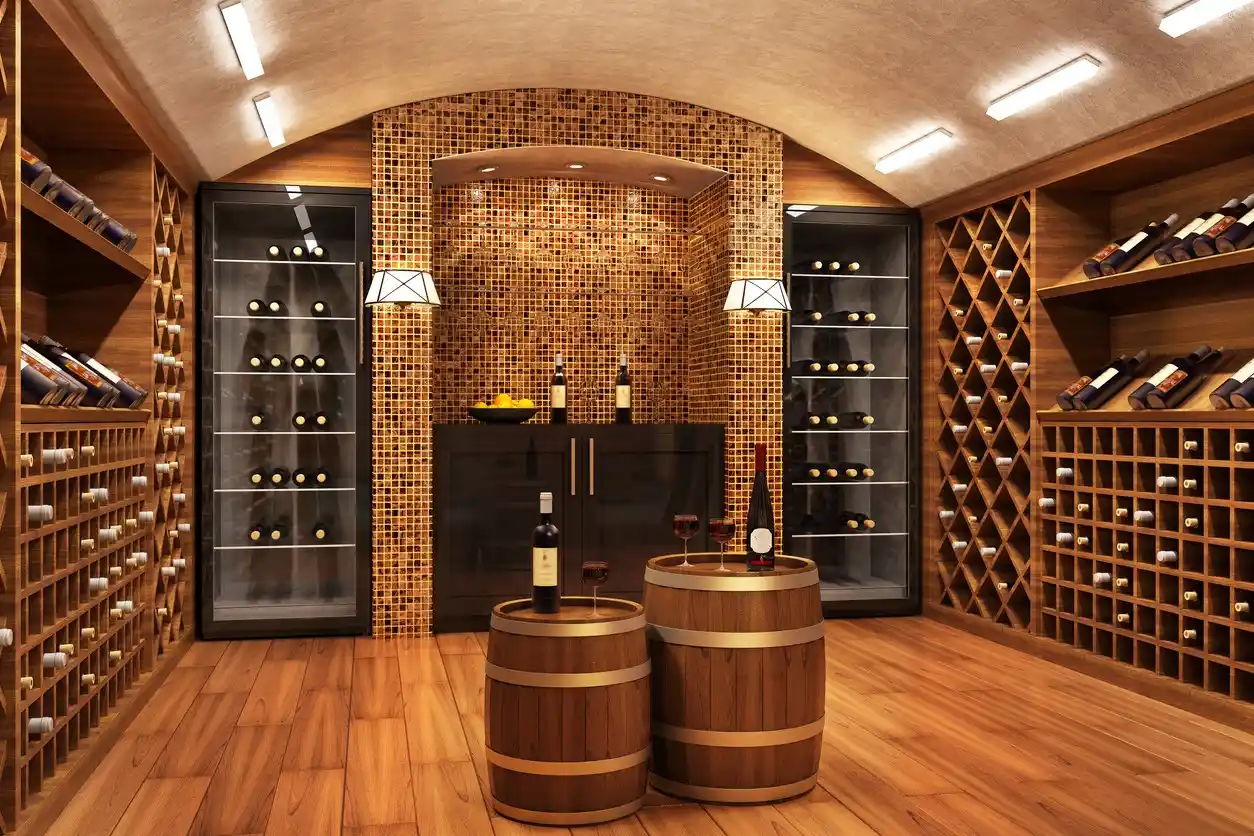
What You Get With Our Wine Cellar Cooling Systems
When you commission a dedicated cooling solution, you are purchasing precision control. We do not simply install a window unit in a basement room; we design a climate-controlled ecosystem. The systems we deploy are capable of maintaining temperature accuracy within one degree, ensuring that your reds and whites are stored at their optimal aging points.
Advanced Humidity Management
Our systems go beyond temperature reduction. They actively manage moisture.
- Integrated Humidification: Some units come with integrated humidifiers to add moisture during dry winter months.
- Condensate Management: During humid summers, the system removes excess moisture without drying out the room entirely, striking the perfect balance for cork health.
- Mold Prevention: By keeping humidity below 75%, we prevent mold growth on labels and corks, which is a common issue in poorly ventilated basements in Dyer.
Quiet and Low-Vibration Operation
A loud compressor is not only annoying but also harmful to wine.
- Split Systems: We often recommend split systems where the noisy condenser is located outside the home or in a mechanical room, while the quiet evaporator is inside the cellar.
- Dampening Technology: Units are mounted using vibration-dampening brackets and materials to ensure the stillness required for proper aging.
Diverse Unit Configurations
Every home and cellar layout is different. We offer access to top-tier brands like WhisperKOOL and CellarPro, with various configurations to suit your build.
- Through-the-Wall Units: Ideal for smaller cellars where venting into an adjacent temperature-controlled room is possible.
- Ducted Systems: These allow for the cooling unit to be completely hidden, with cool air ducted into the cellar and warm air ducted out. This is the most aesthetic option as no equipment is visible inside the cellar.
- Ductless Split Systems: Similar to mini-splits but engineered specifically for lower temperatures (55°F) which standard mini-splits cannot handle efficiently.
How We Install & Maintain Your Wine Cellar's Climate Control
The installation of a wine cooling unit is the final step in a much larger process of cellar construction and preparation. A cooling unit installed in a room without proper preparation will fail, leading to condensation issues, mold in the walls, and equipment burnout.
The Importance of the Thermal Envelope
Before we install the mechanical system, we verify the integrity of the room’s thermal envelope.
- Vapor Barrier: This is the most critical element. A 6-mil poly vapor barrier must be installed on the warm side of the insulation to prevent moisture migration. Without this, the humidity difference between the cellar and the rest of the house will cause condensation to rot your wall studs.
- Insulation Values: We look for R-13 to R-19 insulation in the walls and R-19 to R-30 in the ceilings to reduce the thermal load on the cooling unit.
- Door Seals: An exterior-grade door with weather stripping and a bottom sweep is non-negotiable to keep the cold air in.
The Installation Process
Once the envelope is verified, our technicians proceed with the mechanical installation.
- Load Calculation: We perform a Manual J load calculation specific to wine cellars, accounting for glass walls, lighting, and bottle capacity.
- Line Set Running: For split systems, we run copper line sets through walls or ceilings, ensuring no kinks and proper insulation to prevent sweating.
- Drainage Setup: Cooling units produce condensate. We ensure this water is drained properly, either via gravity or a condensate pump, to a suitable drain line.
- Electrical Connections: We handle the necessary hardwiring or dedicated circuit installation to support the unit’s amperage requirements.
Ongoing Maintenance Protocols
Mr.Freeze Heating & Cooling recommends a structured maintenance schedule to extend the life of your unit. Wine cellar units run almost continuously, much more than standard AC.
- Coil Cleaning: Dirty condenser coils increase energy consumption and can cause the compressor to overheat. We clean these regularly.
- Filter Replacement: Keeping air filters clean ensures proper airflow and prevents dust from settling on your bottles.
- Refrigerant Checks: We monitor pressure levels to detect small leaks before they result in a system failure.
Choosing the Right Cooling Unit for Your Wine Cellar
Selecting the correct unit involves more than just matching cubic footage. We analyze the specific "heat load" of your space. Factors such as the location of the cellar (basement vs. main floor), the amount of glass (which has very poor insulation value compared to a wall), and the type of lighting used all impact the size of the unit needed.
Self-Contained vs. Split Systems
- Self-Contained: These are all-in-one units. They are generally more affordable and easier to install. However, they require a place to exhaust hot air. You cannot vent hot air into a small closet; it must go into a space that is large and well-ventilated, roughly twice the size of the cellar.
- Split Systems: These separate the evaporator and condenser. This is the professional choice for larger collections or for cellars where noise is a concern. They are more complex to install but offer superior longevity and repairability.
Ducted Options for Aesthetics
For collectors who want their cellar to look like a showroom, a ducted system is the answer.
- Zero Footprint: No mechanical box takes up space on the wall or racking.
- Airflow Distribution: Ductwork allows for better distribution of cold air throughout the room, eliminating hot spots in larger cellars.
- Noise Elimination: With the mechanicals up to 25 feet away, the cellar remains silent.
Sizing and Capacity
Undersizing a unit means it runs constantly, failing to reach the set point and burning out early. Oversizing can be equally problematic, as the unit will short-cycle (turn on and off rapidly), which prevents it from properly dehumidifying the space. We ensure the unit is sized perfectly for the specific thermal load of your project in Dyer.
Understanding the Costs and Benefits of Optimal Wine Storage
Investing in a dedicated cooling system involves upfront costs for equipment and installation, as well as ongoing energy costs. However, when weighed against the value of the wine being stored, the ROI is clear.
Operational Efficiency
Modern wine cellar cooling units are far more energy-efficient than older models or converted window AC units.
- EC Motors: Electronically Commutated motors vary their speed based on demand, using a fraction of the electricity of standard motors.
- Smart Thermostats: Integration with smart controls allows for precise monitoring and alerts. If the temperature rises unexpectedly, you receive an alert on your phone, allowing you to save the collection before damage occurs.
Protecting Liquid Assets
A collection of 500 bottles could easily be valued at tens of thousands of dollars. A heat spike can cook the wine, making it flat or vinegar-sour. The cost of a proper cooling system is a small insurance premium to pay to protect the appreciation of vintage wines.
Home Value
A functioning, climate-controlled wine cellar is a luxury feature that adds significant resale value to a home. It signals to buyers that the home is high-end and well-maintained. Conversely, a cellar that smells musty or cannot hold temperature is a liability.
Credentials and Service Differentiators
Installing wine cellar cooling requires a different skill set than standard residential HVAC. It involves refrigeration principles more akin to commercial walk-in coolers. We possess the specific certifications and technical knowledge required to handle these sensitive systems.
- Specialized Training: Our technicians are trained on specific wine cellar brands and understand the nuances of low-temperature refrigeration.
- Code Compliance: We are well-versed in the building codes and permit requirements for Dyer, IN. This includes electrical safety, refrigerant handling, and condensate disposal regulations.
- Holistic Approach: We don't just fix the machine; we look at the room. If we detect that insulation is insufficient or that the door seal is failing, we will advise you, because even the best machine cannot cool a leaky room.
- Rapid Response: We understand that if a cooling unit goes down in July, time is of the essence. We prioritize repair calls for wine cellars to prevent temperature spikes that could damage your inventory.
When you choose us, you are choosing a partner dedicated to the preservation of your collection. We provide clear assessments, transparent installation timelines, and the technical expertise to handle complex split systems and ducted configurations.
Preserve Every Bottle at Its Best
Proper climate control is the difference between a closet with wine in it and a true wine cellar. Ensure your collection matures exactly as the winemaker intended.
Secure the future of your wine collection today—contact Mr.Freeze Heating & Cooling to schedule your on-site assessment.